


 العربية
 Français
 Português
 گؤنئی آذربایجان
 Türkçe
 Lietuviškai
 Español
 Русский
Cable
LMR-400 vs LMR-600 Coaxial Cable: Which Should You Choose?
If you’re specifying cable for a VSAT antenna, two-way radio system, or any RF installation, you’ve likely hit the same question: LMR-400 or LMR-600? Both are Times Microwave Systems’ most popular flexible coax cables — low loss, UV-resistant, and built for outdoor use. The difference comes down to run length, signal loss budget, and how much space you have to work with.
This guide gives you the specs, the attenuation data, and a clear decision rule.
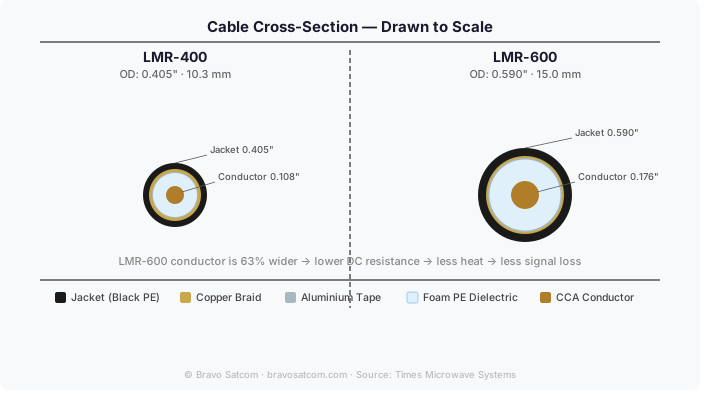
Physical Specs: Side by Side
| Property | LMR-400 | LMR-600 |
|---|---|---|
| Outer Diameter | 0.405″ (10.3 mm) | 0.590″ (15.0 mm) |
| Center Conductor OD | 0.108″ | 0.176″ |
| Center Conductor Material | Copper-clad aluminum | Copper-clad aluminum |
| Minimum Bend Radius | 1.0″ (25 mm) | 1.5″ (38 mm) |
| Weight | 0.068 lbs/ft | 0.131 lbs/ft |
| Impedance | 50 Ω | 50 Ω |
| Temperature Range | −40°C to +85°C | −40°C to +85°C |
| DC Resistance (center, per 1000 ft) | 1.39 Ω | 0.53 Ω |
The bigger conductor in LMR-600 (0.176″ vs 0.108″) is the reason it outperforms LMR-400 on signal loss — lower DC resistance means less energy dissipated as heat per foot of cable.
Signal Attenuation: The Numbers That Matter
Attenuation is measured in dB per 100 feet — the lower the number, the better. Based on Times Microwave Systems official specifications:
| Frequency | LMR-400 | LMR-600 | Improvement |
|---|---|---|---|
| 100 MHz | ~1.0 dB/100ft | ~0.65 dB/100ft | ~35% less loss |
| 450 MHz (L-band) | ~1.7 dB/100ft | ~1.1 dB/100ft | ~35% less loss |
| 900 MHz | ~2.6 dB/100ft | ~1.7 dB/100ft | ~35% less loss |
| 1,500 MHz (VSAT IF) | ~3.5 dB/100ft | ~2.2 dB/100ft | ~37% less loss |
| 2,000 MHz | ~4.2 dB/100ft | ~2.7 dB/100ft | ~36% less loss |
| 2,500 MHz | ~4.8 dB/100ft | ~3.1 dB/100ft | ~35% less loss |
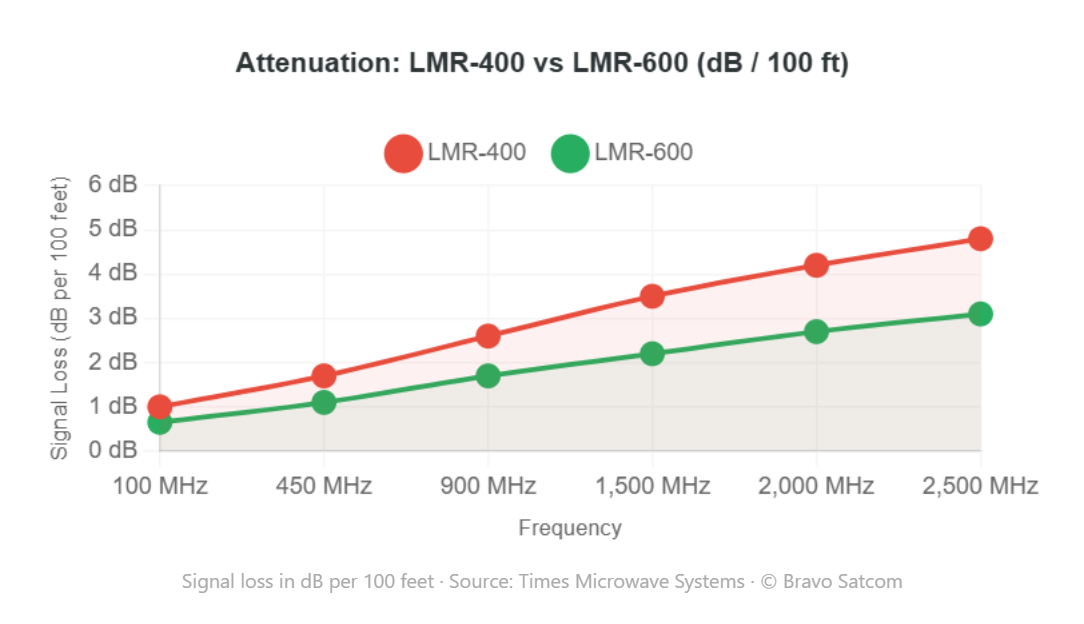
LMR-600 delivers roughly 35% less attenuation at all frequencies compared to LMR-400. That gap compounds quickly over longer runs.
LMR-400: ~3.5 dB loss | LMR-600: ~2.2 dB loss | Difference: 1.3 dB — meaningful when your modem’s link budget is already tight.
When LMR-400 Is the Right Choice
LMR-400 is the industry standard for good reason. Choose it when:
Run length is under 30 metres (100 ft). At this distance, the loss difference between LMR-400 and LMR-600 is minimal and doesn’t justify the cost or weight difference.
You need flexibility. With a 1.0″ minimum bend radius, LMR-400 is significantly easier to route through conduit, around corners, and in tight equipment racks.
Weight matters. At 0.068 lbs/ft (vs 0.131 lbs/ft for LMR-600), LMR-400 is nearly half the weight — important for rooftop or tower installations where cable tray loading is a concern.
Budget is a factor. LMR-400 is meaningfully less expensive per metre than LMR-600, making it the practical default for short-to-medium runs.
LMR-400 is the cable of choice for most VSAT antenna-to-modem runs, two-way radio base station feeders, and short rooftop drops.
When You Should Upgrade to LMR-600
Move to LMR-600 when signal loss budget is tight:
Run length exceeds 30–40 metres (100–130 ft). Beyond this point, the accumulated loss in LMR-400 starts eating into your link margin — especially at higher frequencies (Ku-band IF at 950–1,450 MHz and above).
High-power applications. LMR-600’s larger conductor handles more RF power before thermal losses become a concern — relevant for high-wattage BUC installations where every dB matters.
You’re running at 1 GHz or above over long distances. Attenuation increases with frequency. A 60-metre Ku-band IF run at 1,500 MHz in LMR-400 loses ~7.0 dB. In LMR-600, the same run loses ~4.4 dB. That 2.6 dB difference can be the margin between a stable link and intermittent dropouts.
Maximum cable run distances: LMR-600 supports antenna cable runs up to 400 ft (120 m) without inline amplification. LMR-400 is typically limited to around 200 ft (60 m) before loss becomes unacceptable at Ku-band frequencies.
Cost and Installation
LMR-600 typically costs 30–50% more per metre than LMR-400. It’s also heavier and stiffer, requiring more careful routing and stronger support hardware — cable trays and support clamps need to account for the increased weight (0.131 lbs/ft vs 0.068 lbs/ft).
Connectors are cable-specific — don’t mix LMR-400 and LMR-600 connectors. If you’re terminating in the field, LMR-600 requires a larger stripper tool and more robust crimp or compression fittings. Both cables accept Times Microwave Systems EZ push-on connectors, which eliminates soldering on site.
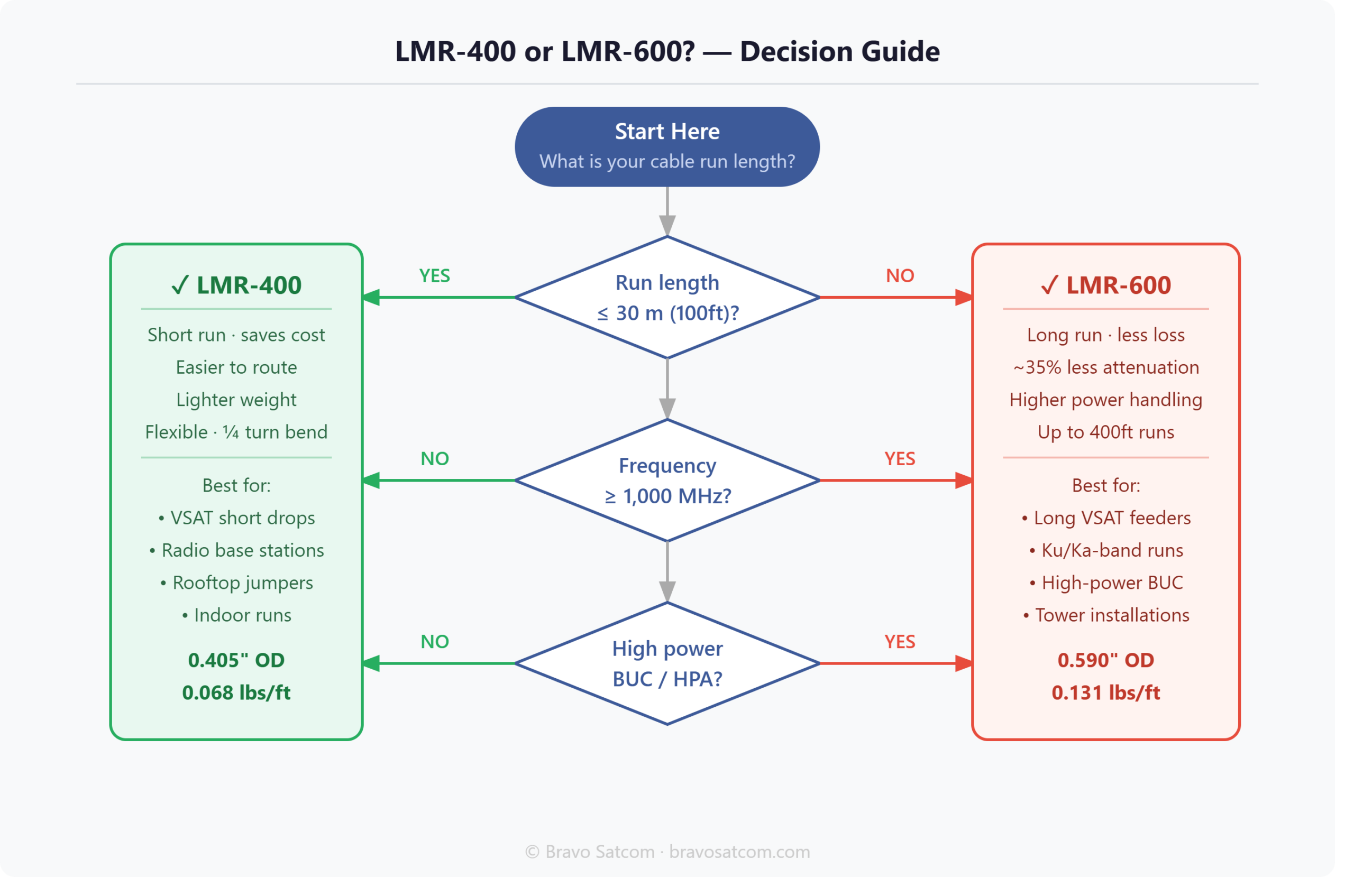
The Simple Decision Rule
Over 30 m, or high frequency, or high-power BUC? → LMR-600.
If you’re ever in doubt, calculate your total path loss budget: add up the cable loss, connector insertion loss (~0.1 dB per connector), and any other passive components. If the total pushes you within 1–2 dB of your link margin, upgrade to LMR-600.
Frequently Asked Questions
Can I mix LMR-400 and LMR-600 in the same run?
Yes, but only with proper barrel adapters. Keep the LMR-600 section on the longer runs and use LMR-400 for short flexible jumpers at each end.
Are LMR-400 and LMR-600 connectors interchangeable?
No. Each cable requires its own connector size. LMR-400 and LMR-600 both accept N-type, TNC, and SMA connectors — but in their respective sizes. They are not physically compatible with each other.
Which cable is better for outdoor VSAT installations in hot climates?
Both use a black UV-protected polyethylene jacket rated for −40°C to +85°C, making them suitable for the UAE and GCC climate. For buried runs, specify LMR-DB (watertight/flooded version) from Times Microwave Systems.
Does LMR-600 need different support hardware?
Yes. At 0.131 lbs/ft, LMR-600 requires stronger cable trays and more frequent support points — approximately every 18–24 inches on horizontal runs vs every 24–36 inches for LMR-400.
Shop LMR Coaxial Cable at Bravo Satcom
Bravo Satcom stocks Times Microwave Systems LMR coaxial cable including LMR-400 and LMR-600, along with the full range of N-type, TNC, SMA, and BNC connectors for both cable types. Available for delivery across the UAE and GCC.
Contact us at sales@bravosatcom.com or +971 55 541 5892 for cut lengths, bulk pricing, or pre-terminated assemblies.