Monthly Archives: July 2025

LMR240 vs RG58 Coaxial Cable Comparison

LMR 240 v RG58
LMR240 vs RG58 Coaxial Cable Comparison

LMR240 vs RG58 Coaxial Cable Comparison

Feature LMR240 RG58
Impedance 50 Ohm 50 Ohm
Outer Diameter ~6.1 mm ~4.95 mm
Loss per 100ft @ 100 MHz ~4.2 dB ~7.9 dB
Shielding Foil + 90% Braid ~70% Braid Only
Flexibility Semi-flexible More flexible
UV Resistance Good Varies
Typical Use Wi-Fi, Cellular, GPS, Low-loss runs Short HF/VHF, General radio
Max Frequency Up to 6 GHz (practical) Up to ~1 GHz (practical)
Cost Slightly higher Cheaper

When to Choose LMR240

LMR240 is ideal for longer runs, higher frequencies, and outdoor installations where low loss and good shielding matter.

When to Choose RG58

RG58 works well for short cable runs at lower frequencies where flexibility and lower cost are more important than ultra-low loss.

Belden RG6 Cable

Belden RG6 Cable | High-Quality Coaxial Cable for TV, Satellite & Broadband

Looking for a reliable RG6 cable? The Belden RG6 Coaxial Cable is trusted worldwide for delivering clear signals and minimal interference. Perfect for Cable TV (CATV), satellite TV, CCTV systems, and high-speed internet, Belden RG6 ensures top performance for both residential and commercial installations.

Why Choose Belden RG6 Coaxial Cable?

  • Superior Signal Quality: 75-ohm impedance with excellent shielding for minimal signal loss and interference.
  • Durable and Versatile: Solid copper or copper-clad steel conductor, foamed PE dielectric, and dual or quad shielding for maximum protection.
  • Flexible Installation: Available in plenum-rated, riser-rated, or direct burial versions — ideal for indoor and outdoor use.
  • Trusted Worldwide: Belden is an industry leader known for premium quality coaxial cables.

Belden RG6 Cable Specifications

Feature Details
Impedance 75 Ohms
Frequency Range Up to 3 GHz
Conductor Solid Bare Copper / CCS
Shielding 60% braid + 100% foil or quad shield
Jacket Material PVC, Plenum (CMP), or Riser (CMR)
Certifications UL Listed, RoHS compliant
Applications CATV, Satellite TV, CCTV, Internet

Popular Belden RG6 Cable Models

  • Belden 9116
  • Belden 7915A
  • Belden 1189A

Order Belden RG6 Cable Now

Upgrade your signal transmission with premium Belden RG6 Coaxial Cable. Whether you’re wiring your home theater, satellite dish, or CCTV system, you’ll get reliable performance that lasts.

Shop Belden RG6 Coaxial Cable Now

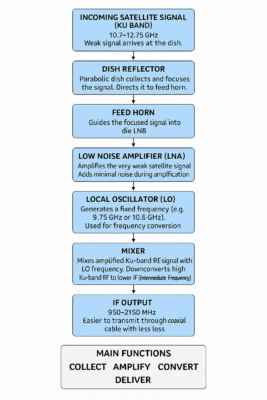
KU Band LNB Working Principle & Flowchart

KU Band LNB Working Principle & Flowchart

Understanding how a KU Band LNB (Low-Noise Block Downconverter) works is crucial for satellite TV and VSAT installers. Below is a simple flowchart explaining the main functions of a KU Band LNB – from receiving KU Band satellite signals to converting and transmitting them to your satellite receiver.

Why Understanding KU Band LNBs Matters

Whether you’re installing satellite TV or setting up VSAT internet, knowing how a KU Band LNB works helps you troubleshoot signal issues, choose the right equipment, and ensure high-quality reception.

Contact us for the best KU Band LNB solutions, satellite dishes, and installation support!

Understanding C Band Frequencies: A Complete Guide

In the world of satellite communications, C Band Frequencies play a crucial role in ensuring reliable, high-quality connections for broadcasting, VSAT, and data transmission. Whether you’re an engineer, network planner, or simply curious about how satellite uplinks and downlinks work, understanding the different C Band frequency ranges and their associated parameters is essential.

Below, we’ll break down the most common C Band Frequencies, including their RF (Radio Frequency), IF (Intermediate Frequency), and Local Oscillator (LO) values.

What is the C Band?

The C Band is a section of the electromagnetic spectrum ranging roughly from 4 GHz to 8 GHz. In satellite communications, the C Band typically covers uplink frequencies from about 5.85 GHz to 7.025 GHz. It is favored for its resilience to rain fade, making it especially popular in tropical regions with high rainfall.

Depending on satellite operators and regional requirements, the C Band is divided into standard, extended, full, and special sub-bands. Each has specific frequency ranges and LO configurations to match the requirements of ground station equipment and satellite transponders.

Common C Band Frequencies

Here’s a quick reference table that summarizes typical C Band Frequencies and their technical specifications:

Frequency Range RF (GHz) IF (MHz) LO (MHz)
Std C 5.85 – 6.425 950 – 1525 7375 / 4900
Ext-Palapa 6.365 – 6.725 1075 – 1435 7800 / 5290
Ext C 6.425 – 6.725 950 – 1250 7675 / 5475
Full C 5.85 – 6.725 950 – 1825 7675 / 4900
Insat C 6.725 – 7.025 965 – 1265 5760
Special C1 5.725 – 6.225 975 – 1475 4750

Why Are There Different C Band Frequencies?

Different regions and satellite operators may define unique frequency blocks within the broader C Band Frequencies to avoid interference and meet local licensing requirements. For example:

  • Std C Band is widely used for traditional commercial satellite services.

  • Extended C Band adds extra spectrum for more capacity.

  • Palapa Band refers to frequencies historically used by the Indonesian Palapa satellite network.

  • Insat C Band is specific to the Indian National Satellite System (INSAT).

  • Special C Bands like C1 cover niche applications or dedicated networks.

Each variation has a tailored LO frequency to convert the RF signal to a manageable IF range for indoor units and modems.

Applications of C Band Frequencies

C Band Frequencies are widely used in:

  • Satellite TV broadcasting

  • VSAT networks for remote internet access

  • Government and defense communications

  • Enterprise private networks in areas prone to heavy rain

Its robust performance in adverse weather conditions makes the C Band an enduring favorite, even as higher bands like Ku and Ka become more popular for certain applications.


Complete Ku-band Frequency Table

Complete Ku-band Frequency Table

Band Name Direction Frequency Range (GHz) Region / Use Case Notes
Standard Ku-band Uplink Earth-to-Satellite 14.00–14.50 Global Main VSAT uplink
Extended Ku-band Uplink Earth-to-Satellite 13.75–14.00 Maritime, enterprise, special services Used for extra capacity where licensed
Standard Ku-band Downlink Satellite-to-Earth 10.70–11.70 Global (FSS) Main VSAT & TV broadcast downlink
Extended Ku-band Downlink Satellite-to-Earth 11.70–12.20 North America (DBS) Used by DirecTV, Dish, etc.
Extended Ku-band Downlink Satellite-to-Earth 12.20–12.75 Europe, Asia, maritime Extra capacity, often used by maritime VSAT

Additional Ku-band Notes

Aspect Details
Typical Dish Size 0.6 m – 1.8 m (VSAT terminals)
Modulation DVB-S2, TDMA, FDMA, SCPC
Applications VSAT Internet, TV Broadcast, SNG (Satellite News Gathering), Maritime, Aeronautical
Rain Fade Sensitivity Moderate to high — higher frequency means more attenuation in heavy rain
Polarization Linear (Horizontal/Vertical) or Circular, depending on satellite operator

Example Regional Allocations

Region Typical Downlink Typical Uplink
ITU Region 1 (Europe, Africa) 10.70–12.75 GHz 13.75–14.50 GHz
ITU Region 2 (Americas) 11.70–12.20 GHz 14.00–14.50 GHz
Maritime / Aero May use full extended bands Same
This site uses cookies to offer you a better browsing experience. By browsing this website, you agree to our use of cookies.